Recognise secondary dominants and weigh a possible key change
Build a dominant for a supplied target, compare complete original contexts, and separate temporary emphasis from evidence that a new key has been established.
By SwarShala publishing desk · Published · 7 min read
Sources checked . AI-assisted; no independent expert review claimed.
The practical starting point
Name the target and check the dominant’s spelling before judging the larger context. One chromatic note or one dominant–target pair does not by itself prove a new key.
Read the target to the right of the slash
A secondary dominant directs dominant function toward a chord other than the current tonic. To construct one, identify the target root, find its dominant, and build the required major triad or dominant seventh; retain any specified inversion. In V7/V, read “dominant seventh of the dominant”: the numeral after the slash names the target. Source: Writing Secondary Dominants.
Take a clearly established C-major setting. V is G major. G's dominant root is D, a perfect fifth above G, so its dominant seventh is D–F-sharp–A–C. Label it V7/V in C major when the context supports its direction toward G. F-sharp is the third of D7 and a semitone below the target root G; it is the distinguishing raised note relative to the C-major scale.
D–F-natural–A–C would be Dm7, with a minor third, and would fail the requested dominant-quality construction. Check both the chord's target and its actual spelling. A chromatic pitch alone does not tell you which chord it belongs to or what that chord is doing.
Keep two slash conventions separate. V7/V names an applied function and target. D7/F-sharp names a D7 chord with F-sharp in the bass. Its slash does not mean “dominant of F-sharp”. Review Roman numerals and seventh-chord spelling before combining these tasks.
Build a dominant for a minor target too
Now tonicize vi, A minor, while retaining C as the surrounding key. The target root is A. Its dominant root is E, and the requested dominant seventh is E–G-sharp–B–D, E7. Write V7/vi → vi, or E7 → Am. The target's minor quality does not make its dominant's third minor.
The raised G-sharp supplies E7's major third and lies a semitone below A. The arrival is A–C–E. A useful two-part check is to construct E7 independently as 0–4–7–10 semitones from E, then verify that its root is a perfect fifth above the target A. These are equal-tempered pitch-distance checks, not instructions for instrumental tuning.
Try ii next without looking ahead: in C major the target is D minor. Its dominant seventh is A–C-sharp–E–G, A7, labelled V7/ii. Replacing C-sharp with C-natural would produce Am7 and lose the requested dominant quality. Retain the target numeral's lowercase ii even though the applied dominant is major–minor.
Compare what happens after the same D7–G pair
Version A adds bars 5–8. Version B instead adds bars 5–10. In both, bars 5–6 contain the same D7–G chords and the same melody. There is no phrase break after bar 6. Follow what happens next before deciding how much tonal weight that G receives.
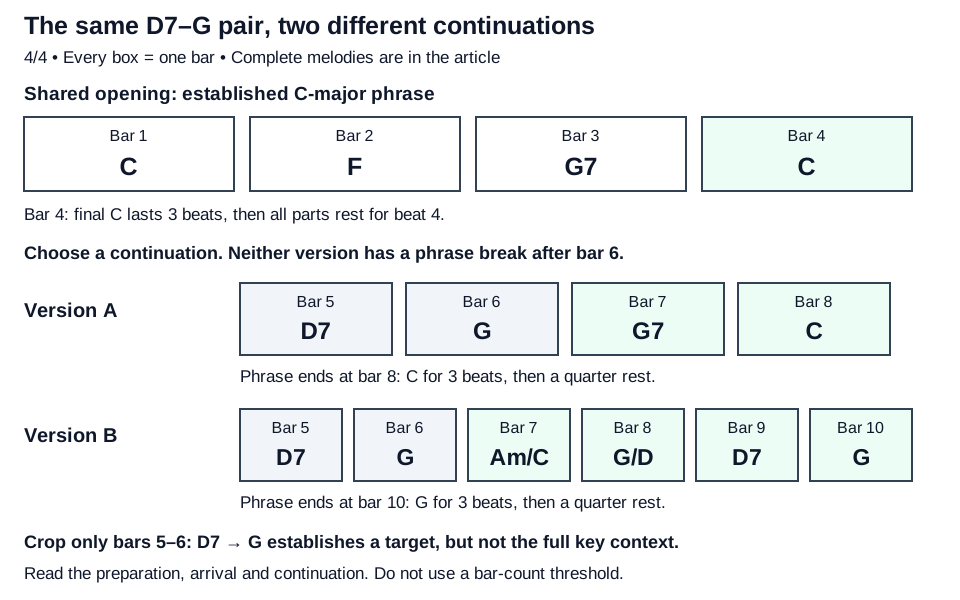
| Version and bar | Chord | Complete melody |
|---|---|---|
| Both: 5 | D7 | F-sharp4 q, A4 q, C5 q, A4 q |
| Both: 6 | G | B4 q, D5 q, G5 q, D5 q |
| A: 7 | G7 | F5 h, B4 h |
| A: 8 | C | C5 dh, rq; phrase ends |
| B: 7 | Am/C | E5 q, C5 q, A4 h |
| B: 8 | G/D | G4 w |
| B: 9 | D7 | F-sharp4 h, D4 h |
| B: 10 | G | G4 dh, rq; phrase ends |
At A's bar 8 and B's bar 10, the accompaniment also lasts three beats then rests for beat 4. Every other continuation chord lasts four beats. Before opening the analysis, identify each final key candidate and list the chords that support it.
Compare the evidence and proposed analyses
A: bars 5–8 read V7/V–V–V7–I in C. D7 locally emphasizes G, but G then becomes G7 and returns to a declared C-major ending. The larger passage supports a tonicization of V within C major.
B: the continuation gives G more than an isolated arrival. In G major, bars 7–10 read ii6–I6/4–V7–I: Am/C–G/D–D7–G. Its phrase closes on G after this cadential preparation. Within the stated tonal framework, this supports analysing a modulation to G. Bar 6's G can be interpreted as V of the old C key or I of the new G key; the later context is what supports reinterpreting its role.
The textbook uses eventual cadential confirmation when distinguishing a new key from local tonicization, while acknowledging ambiguous short cases. It presents the ii6–I6/4–V–I family as a common confirming formula, not a compulsory sequence in every modulation. Source: Tonicization versus Modulation. Here B supplies that fuller context; its extra bars alone are not the deciding rule.
Keep uncertainty when the continuation is missing
Now hide everything after bar 6 in both versions. You see the established C-major opening followed by D7–G, but do not know whether G marks an ending or how the music continues. A justified answer is: “D7 targets G; V7/V–V is a provisional reading in C. This crop does not establish whether the larger passage confirms G as a new key.”
Do not use “one sharp means G major” as a shortcut. F-sharp is required inside this particular D7 in both versions, including A, which returns to C. Conversely, do not declare that a short passage can never modulate. Phrase function, cadential support and what follows matter; there is no universal minimum bar count in this lesson.
For an unfamiliar score, write two separate conclusions: the local dominant target you can establish, and your confidence in a larger key interpretation. If a new-key claim is uncertain, name the missing evidence. This is more useful than forcing every crop into a binary answer.
Construct, label and justify new answers
- In C major, construct V7/ii and name its target chord. Which pitch differs from an all-natural A-minor seventh?
- In G major, construct V7/V. Give the applied chord, its four members and target.
- A learner writes E–G–B–D as V7/vi in C. Repair it and explain the error.
- Does D7/F-sharp in a C-major passage mean “dominant of F-sharp”? Explain both slash conventions.
- Why does Version B support a G-major interpretation more strongly than the cropped bars 5–6?
- Can “the passage lasts six bars” by itself distinguish tonicization from modulation?
Check the construction and context key
- A7, A–C-sharp–E–G, targeting D minor. C-sharp replaces C-natural; the requested dominant has a major third.
- The target V is D major. Its dominant seventh is A7, A–C-sharp–E–G, labelled V7/V in G.
- Raise G to G-sharp: E7, E–G-sharp–B–D, targeting A minor. E–G–B–D is Em7, not the requested dominant seventh.
- No. The chord-symbol slash identifies F-sharp as bass. In the Roman label V7/V, the slash identifies G, the dominant of C, as the tonicized target.
- B supplies a continuing phrase and Am/C–G/D–D7–G at its declared ending, interpretable as ii6–I6/4–V7–I in G. The crop supplies only D7–G with no ending or continuation evidence.
- No. A count is not cadential or functional evidence. State the actual context and retain justified ambiguity.
Download the full paired-context worksheet and answer key. Use phrase-ending cadence analysis to check arrivals, and figured-bass reconstruction if the bass of Am/C or G/D makes its numeral difficult to read.
Sources and scope
Checked 3 October 2026. The exercises, checklists and planning examples are original learning aids, not measured market data or guarantees of learning outcomes.
- Music Theory for the 21st-Century Classroom: Writing Secondary Dominants
Section 17.5 body supports target-first construction, dominant-seventh quality and retention of inversion. All C/G-major construction questions and paired contexts here are original.
- Music Theory for the 21st-Century Classroom: Tonicization versus Modulation
Section 22.2 body and cadential-formula table support contextual confirmation and explicit ambiguity. No source score, recording or performance is reproduced or claimed.
About this guide
SwarShala publishes practical information to help learners compare independent music providers. This guide was prepared with AI assistance and primary-source research. No named educator, teaching credential or independent expert review is claimed.
Editorial standards · Report an error or outdated information