Reconstruct chord pitches from figured-bass inversion numbers
Decode 6, 6/4, 6/5, 4/3 and 4/2 from a supplied bass and key, then check the pitches against Roman numerals and slash-chord symbols.
By SwarShala publishing desk · Published · 7 min read
Sources checked . AI-assisted; no independent expert review claimed.
The practical starting point
Read the Roman numeral in its key, then count the figures upward from the supplied bass. The root and the bass are different reference points; verify both before writing pitches.
Read the key, numeral and bass together
In modern harmonic analysis, figures beside Roman numerals identify inversions through intervals above the bass. They are abbreviations: a triad's first inversion uses 6, its second 6/4; seventh chords use 7, 6/5, 4/3 and 4/2. Read pitches within the supplied key and any applicable alterations. Source: Figured Bass Inversion Symbols.
Here, text such as “V6/5” means V with a vertically stacked 6 above 5, as engraved in the diagram. The slash separating figure numbers is a plain-text convenience, not a bass-note name or a fraction. By contrast, the slash in A7/C-sharp places C-sharp in the bass.
Work through root versus bass and seventh-chord construction first. This guide asks you to reconstruct written pitches from incomplete information. It covers modern analysis shorthand, not the wider performance practice of historical continuo.
Reconstruct I6 above F-sharp3 in D major
The supplied key is D major, whose signature contains F-sharp and C-sharp. The task gives I6 and bass F-sharp3. Use every chord member once, keep the bass fixed, and put each other member at its nearest pitch above that bass. This spacing rule makes the exercise's octave answer specific; the symbol alone does not prescribe one voicing.
- I identifies the D-major triad, D–F-sharp–A. Do not start a new chord on F-sharp merely because it is the bass.
- Expand the triad figure 6 to 6 and 3. Count letter names from the bass inclusively: F–G–A is a third; F–G–A–B–C–D is a sixth.
- Apply the signature. Above F-sharp3, the required notes are A3 and D4. Write F-sharp3–A3–D4.
- Reorder the pitch classes as D–F-sharp–A to check the numeral. The same bass arrangement has the lead-sheet name D/F-sharp.
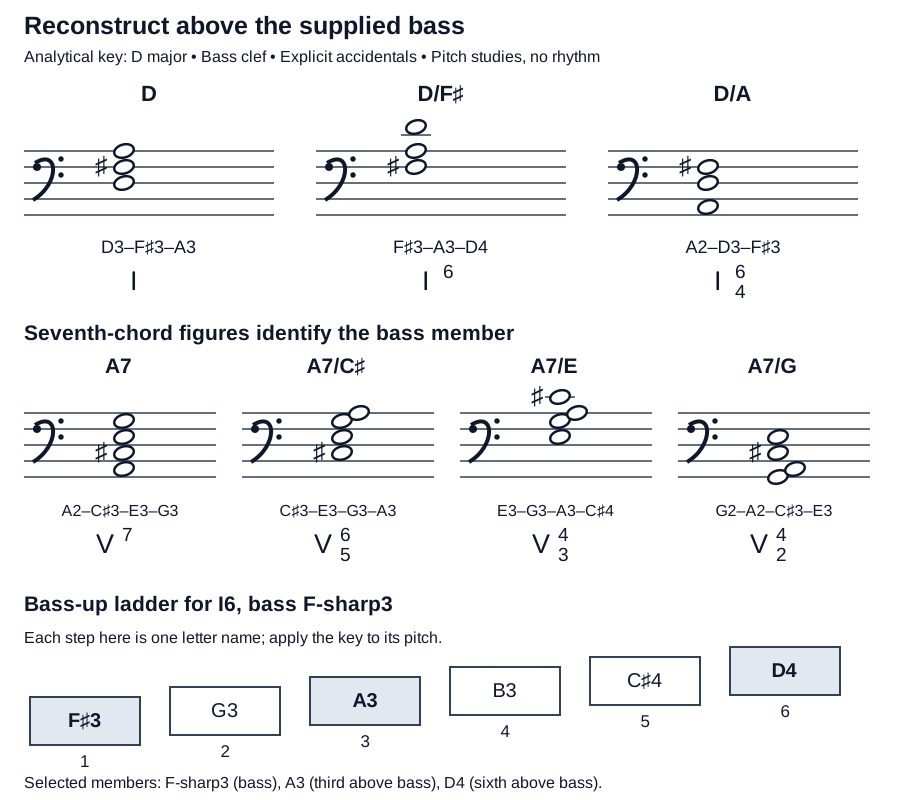
For comparison, root-position I can be D3–F-sharp3–A3. I6/4 with bass A2 becomes A2–D3–F-sharp3: the D is a fourth above A and the F-sharp a sixth. Its slash symbol is D/A. The triad remains D major in all three cases, but the given bass changes which intervals must be counted.
Reconstruct all three inversions of one seventh chord
Stay in D major. V identifies a chord rooted on A; its diatonic seventh chord has A–C-sharp–E–G. Apply the same fixed-bass, nearest-upper-member rule. In the table, the full interval column includes the intervals implied by the abbreviated figure. Source: full versus abbreviated figures.
| Label | Given bass and role | Full intervals above bass | Pitches, low to high | Lead-sheet label |
|---|---|---|---|---|
| V7 | A2; root | 3, 5, 7 | A2–C-sharp3–E3–G3 | A7 |
| V6/5 | C-sharp3; third | 3, 5, 6 | C-sharp3–E3–G3–A3 | A7/C-sharp |
| V4/3 | E3; fifth | 3, 4, 6 | E3–G3–A3–C-sharp4 | A7/E |
| V4/2 | G2; seventh | 2, 4, 6 | G2–A2–C-sharp3–E3 | A7/G |
Check one row independently: in V4/3, E3 to G3 is a third, E3 to A3 a fourth, and E3 to C-sharp4 a sixth. The 4/3 shorthand therefore tells you more than “some inverted chord”: it identifies the seventh chord's fifth as bass. For 6/5 and 4/2, repeat the letter count instead of memorising only a position number.
These inverted-seventh figures already imply a seventh chord; do not add an extra 7 to V6/5. Keep separate quality marks when needed: M for a major seventh, ° for diminished, ø for half-diminished in the source's convention. Source: figures and retained quality symbols.
Keep pitch spelling and quality information
Try a new key: F major, V4/3, bass G3. First identify V7 as C–E–G–B-flat. Then reconstruct above the given G3: G3–B-flat3–C4–E4. G to B is the third required by the figure, and the key supplies B-flat. Writing B-natural would change the chord to Cmaj7/G and fail the supplied V4/3 task.
A quality marker can change a reconstruction too. In D major, IM6/5 over F-sharp3 asks for Dmaj7/F-sharp: F-sharp3–A3–C-sharp4–D4. The M retains the major-seventh quality; 6/5 supplies the inversion. Treat those as separate instructions, then verify the complete collection against D–F-sharp–A–C-sharp.
Historical figured-bass parts may contain chromatically altered figures, beyond the plain analytical abbreviations used in our main set. An alteration beside a figure applies to that interval above the bass, not an interval above the chord root. For a small isolated example in a signature with no sharps or flats, a sharp beside 6 over F3 changes its sixth from D4 to D-sharp4. This single altered interval does not specify a complete chord or a Roman numeral. Source: chromatic alterations in figured bass.
Do not discard a printed alteration to make a memorised inversion chart fit. First determine the bass, signature and the publisher's symbol convention. The original score may require more information than the plain figures covered here.
Repair a root-relative misreading
A learner receives D major, I6/4, bass A2, and writes “D–G–B because G and B are a fourth and sixth above D”. The intervals were counted above the wrong note. The numeral identifies a D-major chord, but the figures refer to the supplied A bass. Repair the answer to A2–D3–F-sharp3, then write D/A beside it.
This is not an instruction to add scale degrees 6 and 4 to a D root. It is also not the lead-sheet symbol D6, which uses a different notation convention. Before translating, state what each component references: key for the numeral, chord root for chord construction, bass for the figures. Those three checks expose mistakes that a memorised inversion name can miss.
Now test consistency: if a worksheet supplied D major, I6, but bass A2, its instructions would conflict. I6 needs the triad's third, F-sharp, in the bass. With A as bass, the correct I label is I6/4. Flag the conflict instead of quietly changing the bass or forcing an invented pitch collection.
Reconstruct a new set before revealing the answers
Use the same spacing rule: retain the given bass, use each chord member once, and place every other member at its nearest pitch above it. Middle C is C4. Give the bass's chord-member role, pitches low to high, and a lead-sheet symbol.
- G major: ii6, bass C4.
- D major: V4/2, bass G3.
- F major: V4/3, bass G3. Explain the required accidental.
- Match 6/5, 4/3 and 4/2 to third, fifth and seventh in the bass.
- Repair D major, I6/4, bass A2, answer A2–D3–F3.
- Is D major, I6, bass A2 a consistent task? Explain the smallest label correction if the bass must stay.
Check the reconstruction key
- C is the third of A minor. C4–E4–A4; Am/C. C to E is a third and C to A a sixth. G major's F-sharp is not a member of this chord.
- G is the seventh of A7. G3–A3–C-sharp4–E4; A7/G. The full intervals above G are 2, 4 and 6.
- G is the fifth of C7. G3–B-flat3–C4–E4; C7/G. B-flat belongs to the supplied F-major signature and is the seventh of C7.
- 6/5: third; 4/3: fifth; 4/2: seventh. The figure names are measured from those bass members.
- Change F3 to F-sharp3, giving A2–D3–F-sharp3; D/A. F-natural would produce D minor, conflicting with I in D major.
- No. A is D major's fifth. Change I6 to I6/4 while retaining A2.
Download the reconstruction worksheet and separate answer key. Then use Roman numerals in a supplied key to keep chord identity separate from its current bass. The primary textbook's practice section provides further independently authored exercises.
Sources and scope
Checked 3 October 2026. The exercises, checklists and planning examples are original learning aids, not measured market data or guarantees of learning outcomes.
- Music Theory for the 21st-Century Classroom: Figured Bass Inversion Symbols
Section 16.2 text and Figures 16.2.1–16.2.5: bass-relative figures, Roman versus slash labels, inverted seventh abbreviations and quality marks. All source figures were inspected; the D-major score and reconstruction tasks here are original.
- Music Theory for the 21st-Century Classroom: Figured Bass Practice Exercises
Section 16.6 provides further practice translating chord symbols and inversion figures. Its exercises are not reproduced here.
- Music Theory for the 21st-Century Classroom: Figured Bass Additional Information
Section 16.5 and its two figures distinguish full interval sets, analytical abbreviations and chromatic alterations in historical figured bass. This guide does not teach continuo realisation.
About this guide
SwarShala publishes practical information to help learners compare independent music providers. This guide was prepared with AI assistance and primary-source research. No named educator, teaching credential or independent expert review is claimed.
Editorial standards · Report an error or outdated information