Find a chord’s root when it is not the lowest note
Separate root from bass, sort octave-labelled voicings, and explain why C/E and C/D describe different kinds of chord arrangement.
By SwarShala publishing desk · Published · 4 min read
Sources checked . AI-assisted; no independent expert review claimed.
The practical starting point
Keep two records: the chord members arranged in thirds to identify its root, and the actual lowest sounding pitch to identify its bass. Do not replace one with the other.
Keep chord identity and actual pitch height separate
The root names the triad when its members are arranged in thirds. The bass is the lowest sounding note in the actual voicing. A triad is in root position with its root in the bass, first inversion with its third in the bass, and second inversion with its fifth in the bass. Source: Music Theory for the 21st-Century Classroom, inverted triads.
Our examples give octave numbers: C4 is middle C; C3 is one octave lower. They describe sounding pitches on a non-transposing instrument or a concert-pitch score. For a transposing part, first establish how its written pitches relate to the rest of the ensemble. A list of unnumbered note names cannot always tell you which note actually sounds lowest.
Start with triad construction if root, third and fifth are new. Here the construction is supplied; the new task is to retain that identity when spacing, order or doubling changes.
Analyse E3–G3–C4 in two passes
- Copy the sounding pitches exactly: E3, G3, C4. E3 is lowest.
- Make a separate identity line using the three letter-and-accidental names. Rearrange C, E, G into consecutive thirds.
- Identify C major: C is the root, E its third, and G its fifth.
- Return to the actual voicing. The bass is E3, a version of the chord's third.
- Record “C major, first inversion, bass E3”. In a lead-sheet symbol, write C/E.
Do not move C4 down to C3 in the sounding record just because you used C at the start of the identity line. The analytical rearrangement helps name the chord; it does not change the given music.
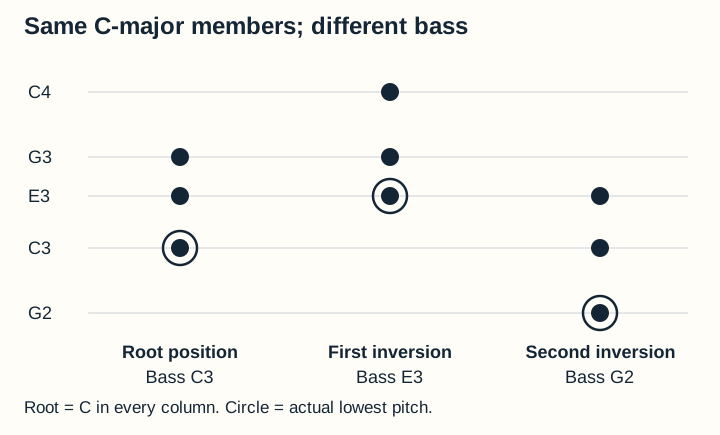
Check open spacing and repeated members
Classify these three voicings, all listed from lowest to highest: A = E3–G3–C4; B = E2–C4–G4; C = E3–C4–E4–G4. Each contains the pitch classes C, E and G. Each has an E as its bass. All three are C major in first inversion.
B spreads the chord over a larger range. C doubles E in another octave. Neither change turns E into the root. The different arrangements may sound different, but this paper task makes no claim that one spacing is best for every instrument or piece.
Now examine the deliberately scrambled list G4, C3, E4. Its first written item is G4, but its lowest sounding item is C3. The chord is C major in root position. Sorting by the order of a typed list would give a wrong answer; compare actual pitch height first.
Read a slash as a bass instruction
A lead-sheet slash symbol places the chord before the slash and the bass pitch class after it. C/E asks for a C-major triad with E in the bass. The symbol does not give every octave, upper-note order, doubling or fingering. A bass outside the triad is also possible. Source: slash-chord subsection.
| Symbol | One complete pitch example | Result |
|---|---|---|
| C/E | E3–G3–C4 | E is C's third: first inversion |
| C/G | G2–C3–E3 | G is C's fifth: second inversion |
| C/D | D3–C4–E4–G4 | D is outside C–E–G: C major over D, not a standard triad inversion |
For C/D, retain both pieces of information. Calling it “third inversion of C major” would be wrong: a triad has only three different chord members available as inversion basses, and D is not one of them. Describing this written symbol does not settle every harmonic interpretation of the same four-note collection in a composition.
Classify new voicings with a reason
For each original case, write root, triad quality, actual bass and position. These lists are not guaranteed to be in pitch order.
- A3, D4, F4.
- C4, F3, A3.
- B3, G2, D4.
- F4, D3, A3, D4.
- A2, G3, B3, D4, explicitly labelled G/A.
Check the classification key
- D minor; bass A3; second inversion. D–F–A identifies the chord and A is its fifth.
- F major; bass F3; root position. The initial typed C4 is not the lowest pitch.
- G major; bass G2; root position.
- D minor; bass D3; root position. Doubling D4 changes neither the root nor the bass.
- G-major triad over bass A2. A is outside G–B–D, so this is not a standard inversion of that triad.
Download the root-and-bass worksheet. If your chord identity was right but its inversion was wrong, practise the pitch-height step. If your root was wrong, practise rearranging only the pitch classes into thirds. Inverting an interval is a different two-note operation; melodic inversion is different again. None supplies a shortcut that replaces checking a complete chord's bass.
Sources and scope
Checked 3 October 2026. The exercises, checklists and planning examples are original learning aids, not measured market data or guarantees of learning outcomes.
- Music Theory for the 21st-Century Classroom: Inverted Triads
Root versus bass, triad positions and lead-sheet slash notation, including a bass outside the triad. All octave-labelled voicings, diagrams and questions here are original.
About this guide
SwarShala publishes practical information to help learners compare independent music providers. This guide was prepared with AI assistance and primary-source research. No named educator, teaching credential or independent expert review is claimed.
Editorial standards · Report an error or outdated information