Build and compare the four triad qualities
Build major, minor, diminished and augmented triads from several roots, checking both letter spelling and interval distance.
By SwarShala publishing desk · Published · 4 min read
Sources checked . AI-assisted; no independent expert review claimed.
The practical starting point
Choose root, third and fifth letter names first. Then adjust their accidentals to fit the required intervals; matching keyboard keys alone does not prove the chord is spelled correctly.
Choose the root, third and fifth letters
A triad is a three-note chord whose members can be arranged in consecutive thirds. In that compact arrangement, its members are the root, third and fifth. Major, minor, diminished and augmented are the four triad qualities taught here. Source: Music Theory for the 21st-Century Classroom, triads.
Start on D and count letter names inclusively: D–E–F gives the third letter F; D–E–F–G–A gives the fifth letter A. Your working frame is D–F–A. It does not yet decide whether F or A needs an accidental. For an E-flat root, the frame is E–G–B with the root's flat retained: E-flat, some G, some B.
This is a notation construction lesson, not a fingering or listening test. Review interval number and quality if third versus fifth is unfamiliar. On a staff, use clef landmarks before checking accidentals.
Check two thirds and the whole fifth
The quality depends on the third and fifth measured from the root. An additional check is to measure the two adjacent thirds in the compact stack. The table uses semitone distances in twelve-tone equal temperament; it does not prescribe tuning adjustments for an instrument. Source: Open Music Theory, triad qualities.
| Quality | Lower + upper third | Root to fifth | Distances from root |
|---|---|---|---|
| Major | Major + minor: 4+3 | Perfect fifth: 7 | 0, 4, 7 |
| Minor | Minor + major: 3+4 | Perfect fifth: 7 | 0, 3, 7 |
| Diminished | Minor + minor: 3+3 | Diminished fifth: 6 | 0, 3, 6 |
| Augmented | Major + major: 4+4 | Augmented fifth: 8 | 0, 4, 8 |
The first number is zero because you have not moved away from the root. Count the distance between keys, not the number of keys including both endpoints. A major third spans four semitone steps; counting the root as step one would shift your answer.
Build all four qualities from D
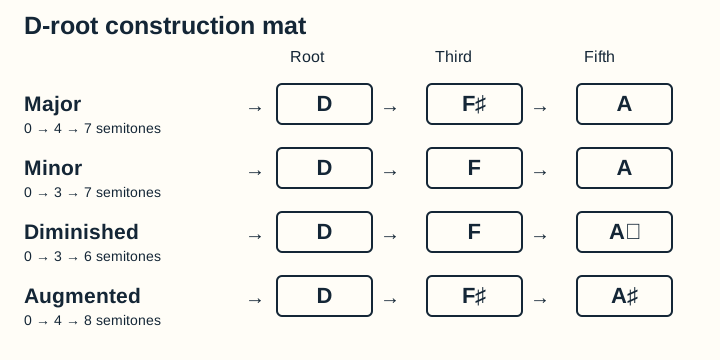
- D major: D–F-sharp is four semitones and F-sharp–A is three. Write D–F-sharp–A.
- D minor: lower the third by a semitone, retaining the fifth. Write D–F–A; its adjacent distances are 3+4.
- D diminished: begin with D minor and lower the fifth. Write D–F–A-flat; the distances are 3+3.
- D augmented: begin with D major and raise the fifth. Write D–F-sharp–A-sharp; the distances are 4+4.
Do not build the augmented chord by raising the fifth of D minor: that would leave its third minor and produce a different collection. A good worksheet includes separate “third checked” and “fifth checked” boxes so one correct member cannot hide the other error.
Repair a plausible keyboard answer
A learner writes “D–G-flat–A” for D major. On an equal-tempered keyboard, G-flat and F-sharp use the same key. However, D to a G is a fourth by letter name, not the required third. Repair G-flat to F-sharp and retain D and A. You have corrected the notation without changing that keyboard pitch.
Try E-flat next. E-flat major is E-flat–G–B-flat. For E-flat minor, lower G to G-flat. For E-flat diminished, also lower B-flat to B-double-flat. For E-flat augmented, use E-flat–G–B-natural. The double flat is needed because a further semitone below B-flat retains the B letter. Writing A-natural instead would hide the fifth's identity.
Stacking in thirds is an identification and construction method. It does not require every performance to keep the notes close together. The same chord members can be spread across registers; root, bass and inversion explains what the lowest sounding member changes.
Check new roots and explain each answer
Hide the table and complete these original questions. Write the letters before doing the semitone check.
- Name A–C–E, giving the two adjacent third distances.
- Name B–D–F, checking the complete fifth too.
- Build F major and F augmented.
- Repair “C–E–A-flat” as a correctly spelled C augmented triad without changing its equal-tempered pitches.
- Why is D–F–A-sharp not the D augmented triad requested above?
Check the answers
- A minor: 3+4; its root-to-fifth distance is 7.
- B diminished: 3+3; B–F spans 6 semitones.
- F–A–C; F–A–C-sharp. Both use F–A as a major third, with perfect and augmented fifths respectively.
- C–E–G-sharp. G supplies the fifth letter; A-flat supplied a sixth letter.
- Its D–F third is minor. D augmented requires F-sharp as well as A-sharp.
Download the triad construction worksheet with room for letter frames, distances and a separate key. After you can explain both checks, continue to seventh-chord construction. Keep key signatures separate from chord symbols: a chord's root name alone does not announce the key of a complete piece.
Sources and scope
Checked 3 October 2026. The exercises, checklists and planning examples are original learning aids, not measured market data or guarantees of learning outcomes.
- Music Theory for the 21st-Century Classroom: Introduction to Triads
Definition, root/third/fifth and the four qualities. Original construction examples here were checked by letter count and semitone arithmetic.
- Open Music Theory: Triads
Triadic qualities and spelling, including retaining letter names when accidentals change. Source artwork and exercises are not reused.
About this guide
SwarShala publishes practical information to help learners compare independent music providers. This guide was prepared with AI assistance and primary-source research. No named educator, teaching credential or independent expert review is claimed.
Editorial standards · Report an error or outdated information