Build seventh chords and distinguish 7, maj7, m7, ø7 and °7
Use the triad and root-to-seventh interval as two separate checks, then repair original chord spellings and compare five common qualities.
By SwarShala publishing desk · Published · 4 min read
Sources checked . AI-assisted; no independent expert review claimed.
The practical starting point
A seventh chord needs two quality checks: the lower triad and the interval from root to seventh. The 7 in G7 does not mean G major seventh.
Keep the triad and seventh as separate checks
A seventh chord has four different members that can be arranged in thirds: root, third, fifth and seventh. This lesson compares five common qualities used in classical and popular theory; it is not a list of every possible seventh chord. Source: Music Theory for the 21st-Century Classroom, seventh chords.
From G, select the letter frame G–B–D–F. The lower three letters will become a triad. The last letter is a seventh above G by inclusive letter counting, whatever accidental it eventually needs. Use triad construction and interval quality as prerequisites rather than trying to memorise an unexplained chord shape.
Write two answer spaces: “triad quality” and “root-to-seventh quality”. Do not measure the final interval only from the fifth. That adjacent interval can help check a stack, but it is not what the second part of “major-minor seventh” names.
Read the five common quality combinations
| Symbol ending | Lower triad | Root to seventh | Quality name |
|---|---|---|---|
| maj7 | Major | Major seventh: 11 semitones | Major-major |
| 7 | Major | Minor seventh: 10 | Major-minor; dominant-seventh quality |
| m7 | Minor | Minor seventh: 10 | Minor-minor |
| ø7 | Diminished | Minor seventh: 10 | Half-diminished |
| °7 | Diminished | Diminished seventh: 9 | Fully diminished |
These symbol forms are declared for this lesson; charts also use variants such as m7♭5 for half-diminished. The semitone counts describe equal-tempered interval distances. In all cases the final member must retain the seventh letter as well as the required distance. Source: Open Music Theory, seventh-chord nomenclature.
Change one component at a time on G
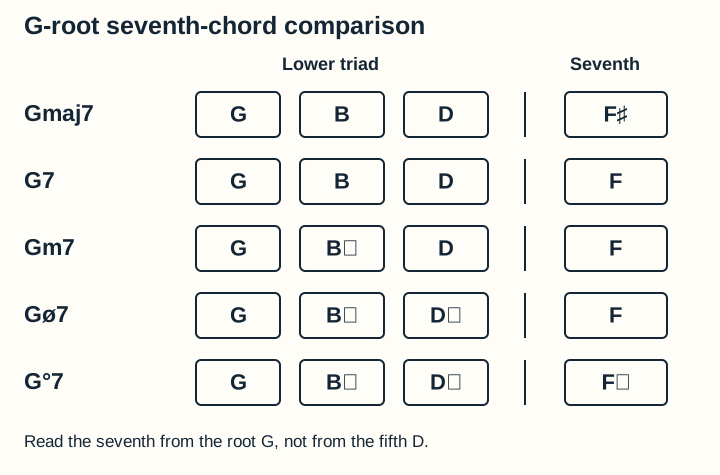
Begin with Gmaj7: G–B–D–F-sharp. Its lower triad is major and G–F-sharp is a major seventh. Lower only F-sharp to F to get G7. Its G-major triad remains intact, while the seventh becomes minor. Lower B to B-flat as well to get Gm7: G–B-flat–D–F.
For Gø7, use G–B-flat–D-flat–F. The fifth has moved down from the minor-seventh example, making the lower triad diminished; the seventh is still minor. For G°7, retain that diminished triad and lower F to F-flat: G–B-flat–D-flat–F-flat. The root-to-seventh span is now nine semitones, a diminished seventh.
Write the distances from G to the four members: Gmaj7 = 0,4,7,11; G7 = 0,4,7,10; Gm7 = 0,3,7,10; Gø7 = 0,3,6,10; G°7 = 0,3,6,9. This arithmetic checks the authored rows independently of an instrument shape.
Avoid two convincing-looking errors
Wrong seventh letter: someone writes G–B-flat–D-flat–E for G°7. E and F-flat share a key in equal temperament, but E is a sixth letter above G. The seventh member must be some F, so write F-flat. A more striking case is C°7: C–E-flat–G-flat–B-double-flat. The last member is a B lowered twice, not an A renamed for convenience.
Quality mistaken for function: G7 describes a major triad with a minor seventh. That is called dominant-seventh quality. In a C-major context, a G7 moving to C can serve a dominant role. The symbol alone, without a key and surrounding music, does not establish that role. Do not decide a whole piece's tonic from one chord.
Likewise, the chordal seventh is measured from that chord's root; it is not necessarily scale degree seven of the current key. When you compare keys, use the separate tonic-and-signature method. When inspecting minor-key material, do not assume one fixed set of notes for every context; review the three classical minor forms.
Construct and diagnose new cases
Complete the following before revealing the key. For every answer, name the lower triad and the root-to-seventh interval.
- Build Dmaj7, D7 and Dm7.
- Compare Bø7 and B°7 while keeping their lower three members the same.
- Name C–E–G–B-flat and C–E–G–B.
- Repair the last member of C–E-flat–G-flat–A if the requested spelling is C°7.
- A chart says F7 but supplies no surrounding music. What can you identify, and what remains undecided?
Check the complete answer key
- Dmaj7 = D–F-sharp–A–C-sharp (major/major seventh); D7 = D–F-sharp–A–C (major/minor seventh); Dm7 = D–F–A–C (minor/minor seventh).
- Bø7 = B–D–F–A; B°7 = B–D–F–A-flat. Both have B diminished below; their sevenths are minor and diminished respectively.
- C7 (major-minor) and Cmaj7 (major-major). A plain 7 and maj7 are not interchangeable.
- Use B-double-flat, preserving the seventh letter while retaining the equal-tempered pitch.
- F–A–C–E-flat, a dominant-seventh-quality chord. Its harmonic function in a particular key is not settled by that symbol alone.
The seventh-chord worksheet keeps the two quality checks separate and supplies blank letter frames. If an answer fails, identify whether its triad, seventh distance or letter spelling is wrong before rebuilding it. For a low note that differs from the root, continue with root versus bass; do not silently reorder the actual sounding pitches.
Sources and scope
Checked 3 October 2026. The exercises, checklists and planning examples are original learning aids, not measured market data or guarantees of learning outcomes.
- Music Theory for the 21st-Century Classroom: Introduction to Seventh Chords
Four-note construction and five common seventh-chord families, explicitly not an exhaustive set. Original G, D, B, C and F exercises are not copied from the chapter.
- Open Music Theory: Seventh Chords
Nomenclature matrix, root-relative seventh quality and spelling principles. Emotional labels and source recordings are outside this guide; no ear-training or listening result is claimed.
About this guide
SwarShala publishes practical information to help learners compare independent music providers. This guide was prepared with AI assistance and primary-source research. No named educator, teaching credential or independent expert review is claimed.
Editorial standards · Report an error or outdated information