Read a chord progression with Roman numerals
Map D–Bm–G–A in a supplied D-major key, recover its pattern in F major, and keep chord degree, quality and voicing separate.
By SwarShala publishing desk · Published · 5 min read
Sources checked . AI-assisted; no independent expert review claimed.
The practical starting point
Write the key first. The numeral names the chord root’s scale degree; its case records quality. Preserve both when recovering a progression in a different key.
Start with a supplied key and a declared convention
Roman-numeral chord labels describe harmony relative to a key. Here uppercase means a major triad, lowercase a minor triad, a small ° marks diminished and + marks augmented. The numeral follows the root's scale degree, even when another chord member is in the bass. Source: Open Music Theory, Roman Numerals.
Our first task supplies D major. Its scale is D–E–F♯–G–A–B–C♯. Number these notes 1–7 before labelling any chord. If you need to construct that collection, use the major-scale pattern guide. Do not infer the key merely because the first chord is D: the supplied key is part of this exercise's information.
Use two working columns: root degree and chord quality. A root on degree 6 does not by itself tell you whether its chord is major or minor. Read the complete chord name or inspect its notes, then combine the two answers.
Encode D–Bm–G–A in D major
| Chord | Spelled triad | Root degree | Quality | Numeral |
|---|---|---|---|---|
| D | D–F♯–A | 1 | Major | I |
| Bm | B–D–F♯ | 6 | Minor | vi |
| G | G–B–D | 4 | Major | IV |
| A | A–C♯–E | 5 | Major | V |
The result is I–vi–IV–V. Check Bm especially: B is the sixth scale degree, while B–D is a minor third. Writing VI would keep B as the root but request a major triad, B–D♯–F♯. It would change D to D♯, not move the root to a different scale degree.
Keep “minor chord” and “minor key” separate. Bm is a minor chord within this supplied D-major setting. The lowercase vi does not change the exercise's key to B minor. Similarly, a major chord can appear within a minor-key setting.
Recover the same pattern in F major
Write F–G–A–B♭–C–D–E and number it 1–7. Read I–vi–IV–V one symbol at a time: choose root 1 and major quality, root 6 and minor quality, root 4 and major quality, then root 5 and major quality. This produces F–Dm–B♭–C.
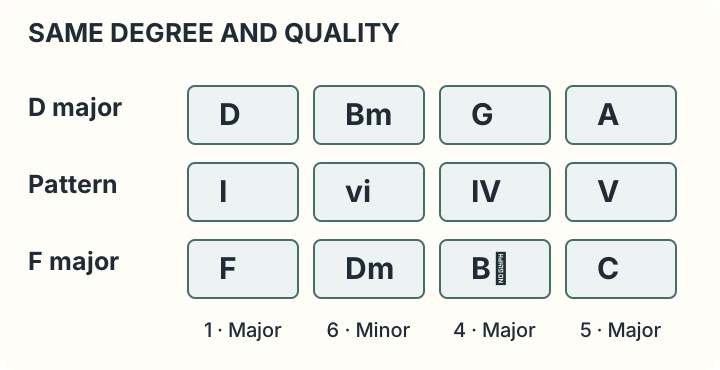
| Numeral | Root degree | Quality | Chord and notes |
|---|---|---|---|
| I | 1: F | Major | F: F–A–C |
| vi | 6: D | Minor | Dm: D–F–A |
| IV | 4: B♭ | Major | B♭: B♭–D–F |
| V | 5: C | Major | C: C–E–G |
A frequent copying error is to carry the old key's F♯ into Dm. Rebuild from the new key and specified quality instead. Another is to write B natural for IV: F major's fourth degree is B♭. To check triad spelling separately, revisit the four triad qualities.
Declare what minor keys and accidental prefixes mean
For natural-minor examples here, the diatonic triads use i–ii°–III–iv–v–VI–VII. In tonal minor, raising the leading tone creates major V or diminished vii°; those labels conventionally reflect the raised leading tone. Source: minor-key Roman numerals. This is a stated convention, not permission to mix minor-numeral systems silently.
In supplied A minor, compare i–iv–v–i with i–iv–V–i. Their spellings are A–C–E, D–F–A, E–G–B, A–C–E for the first; change only G to G♯ in the third chord for the second. The root remains E. An uppercase V encodes that quality change without pretending A minor has become A major.
For chromatic prefixes in our major-key examples, ♭ or ♯ before a numeral lowers or raises its root relative to the supplied major scale; case still supplies chord quality. The sign need not become a literal flat or sharp in the root's final spelling. Source: analysing borrowed chords. Thus in D major, ♭VI is B♭ major, B♭–D–F. VI without the prefix would have B as root.
Some systems compare even minor-key roots with the parallel major scale and consequently use labels such as ♭III and ♭VI in minor. Our natural-minor labels above do not. Before borrowing an analysis from another chart, identify its reference scale. We do not analyse chromatically prefixed minor-key numerals in this exercise.
Keep a chord label separate from its role and voicing
D3–F♯3–A3 and F♯2–A2–D3 both contain the D-major triad. Their root-degree and quality label in D major is I, but their bass notes differ. A fuller analysis can append inversion figures; our two-column exercise deliberately leaves inversion unmarked. Source: analysing root and optional inversion figures. See root, bass and inversions for that separate check.
The pattern I–vi–IV–V also leaves register, doubling, rhythm and phrase placement unspecified. It does not by itself prove which chord feels like a destination, that a particular cadence occurred, or that the supplied tonic would be the only plausible hearing of an unfamiliar song. Those questions need the surrounding music. First make the label accurate; then gather the context needed for a functional analysis.
Practise the conversion in both directions
- In supplied G major, label G–Em–C–D. Spell every chord.
- Recover ii–V–I in supplied B♭ major, including every accidental.
- In D major, what changes between vi and VI?
- Can the bare root-and-quality label IV tell you the chord's lowest note?
Check the conversion answers
- I–vi–IV–V. G–B–D; E–G–B; C–E–G; D–F♯–A.
- Cm–F–B♭: C–E♭–G; F–A–C; B♭–D–F. B♭ major contains both B♭ and E♭.
- B–D–F♯ becomes B–D♯–F♯. The root remains degree 6; the quality becomes major.
- No, not in this exercise's deliberately inversion-free notation. Inspect the actual voicing or an explicit inversion/bass instruction.
Use the two-key worksheet and answer key. Cover the answers, complete root degree and quality separately, then compare both columns before accepting a numeral.
Sources and scope
Checked 3 October 2026. The exercises, checklists and planning examples are original learning aids, not measured market data or guarantees of learning outcomes.
- Open Music Theory: Roman Numerals
Freshly read root-scale-degree and case conventions, diminished/augmented signs, minor-key leading-tone convention and analysis with optional inversion figures. All progression tables and transfer questions here are original; the key is supplied rather than inferred.
- Music Theory for the 21st-Century Classroom: Analyzing and Writing Borrowed Chords
Section 19.3 supports altered Roman roots relative to the prevailing major key, rather than treating every prefix as a literal written accidental.
About this guide
SwarShala publishes practical information to help learners compare independent music providers. This guide was prepared with AI assistance and primary-source research. No named educator, teaching credential or independent expert review is claimed.
Editorial standards · Report an error or outdated information