Identify a cadence using the whole phrase
Classify four alternative endings of one original phrase, and explain why a V–I motion in its middle is insufficient to establish a cadence.
By SwarShala publishing desk · Published · 6 min read
Sources checked . AI-assisted; no independent expert review claimed.
The practical starting point
Locate the phrase ending before naming its harmonic arrival. A pair of chord symbols needs musical context; the same V–I motion can occur while a phrase continues.
Find the arrival before naming it
A cadence is a harmonic arrival associated with a phrase ending. This introductory Western tonal lesson uses four labels: authentic for V–I, plagal for IV–I, deceptive for the common major-key V–vi ending, and half for an ending on V. These are the chapter's basic categories; V–vi is not every possible deceptive ending. Source: Cadences, Section 7.4.
First establish the key and phrase boundary. Then identify the final chord and the preceding harmony. In a score, duration, rests, melodic shape and explicit phrase markings can help you investigate an arrival. A barline or familiar two-chord pattern alone does not settle it. This guide supplies complete note durations and an explicit phrase boundary so you can practise the classification without guessing where the extract stops.
All examples below are in C major. I is C–E–G; IV is F–A–C; V is G–B–D; vi is A–C–E; ii is D–F–A. Review major-scale construction if the scale-degree roots are unfamiliar. Uppercase and lowercase distinguish the major and minor triads in these exercises.
Read the shared six-bar opening
Write one phrase bracket over bars 1–8. The metre is 4/4. Choose one two-bar ending from the next section after these six shared bars. There is no phrase break at bar 4. Melody pitches use scientific octave numbers, with C4 as middle C. q means a quarter note, h a half note, dh a dotted half note, and rq a quarter rest.
| Bar | Chord for all four beats | Complete melody, in order |
|---|---|---|
| 1 | C (I) | C5 q, E5 q, G5 h |
| 2 | F (IV) | F5 q, A5 q, C6 h |
| 3 | G (V) | B5 q, G5 q, D5 q, B4 q |
| 4 | C (I) | C5 q, E5 q, G5 q, E5 q |
| 5 | Am (vi) | A4 q, C5 q, E5 h |
| 6 | Dm (ii) | D5 q, F5 q, A5 h |
The accompaniment voicings are C3–E3–G3 for C; F2–A2–C3 for F; G2–B2–D3 for G; A2–C3–E3 for Am; and D3–F3–A3 for Dm. Sustain the specified accompaniment for the whole bar except for the final bar's stated rest. These are written teaching examples, not a claim about a recorded performance or a four-part counterpoint exercise.
Follow the melody's durations as well as the chord names. Bars 3 and 4 contain uninterrupted quarter-note motion; the phrase bracket continues through them. The end is still four bars away. The complete table prevents a crop of G followed by C from silently becoming the whole example.
Attach one of four endings
Use the shared bars 1–6 unchanged. Each row below supplies bars 7 and 8. In bar 7 the accompaniment lasts all four beats. In bar 8 both the chord and final melody note last three beats, followed by a quarter rest in all parts. The phrase ends after bar 8. Thus every version contains 32 quarter-note durations, including its final rest.
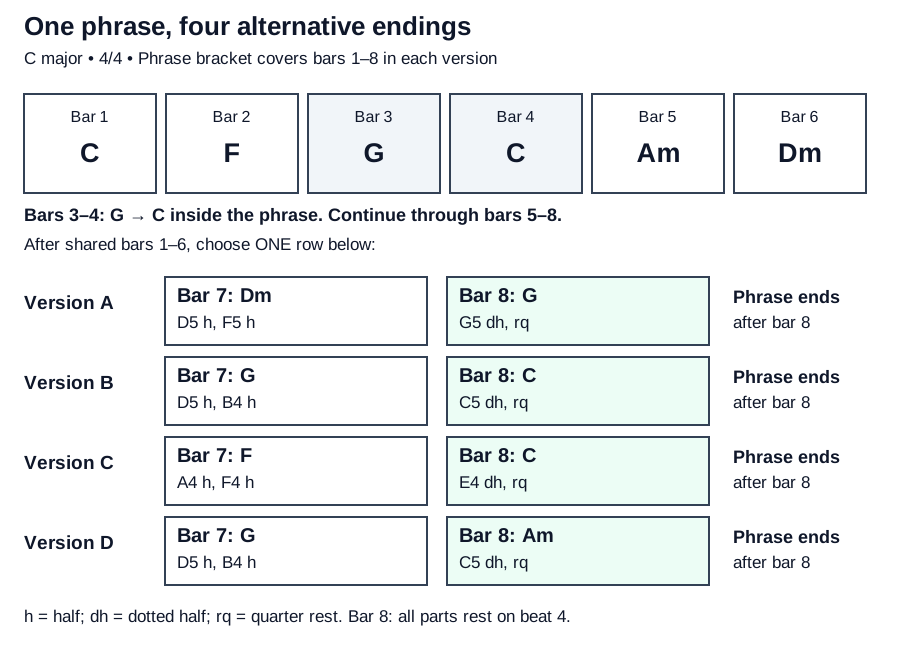
| Version | Bar 7: chord and melody | Bar 8: chord and melody |
|---|---|---|
| A | Dm: D5 h, F5 h | G: G5 dh, rq |
| B | G: D5 h, B4 h | C: C5 dh, rq |
| C | F: A4 h, F4 h | C: E4 dh, rq |
| D | G: D5 h, B4 h | Am: C5 dh, rq |
Before revealing the key, write the final two numerals and a cadence category for each version. Start with the final chord: does it end on V, I or vi? If it ends on I, which chord immediately precedes it?
Check the four endings
- A: ii–V, ending on V; half cadence.
- B: V–I; authentic cadence.
- C: IV–I; plagal cadence.
- D: V–vi; the deceptive-cadence pattern selected for this major-key exercise.
B and C share the final C-major chord, but their approaches differ. B and D share G in bar 7, but their arrivals differ. A ends on a major chord too, yet that chord is V in C major, not I.
Explain the middle-of-phrase decoy
Someone labels bars 3–4 “another authentic cadence because G goes to C”. The chord identification is correct; the cadence conclusion lacks the required ending context. In this supplied example, the phrase continues through bar 4 with quarter-note motion and onward into bars 5–8. Record V–I inside the phrase; no cadence assigned here under the stated segmentation.
This is a reasoning task, not a rule that bar 4 can never end a phrase. If another score marks an arrival there, inspect its complete music. Here the bracket, continued melody and later final rest distinguish the interior event from the designated ending. Keep the harmonic observation and phrase interpretation separate.
Likewise, if the extract consisted only of chord symbols G–C with no key, duration or phrase context, the safest answer would identify a possible V–I in C and request the missing context. It would not establish either the key or a phrase ending with certainty.
Classify new arrivals and state the evidence
Questions 1–4 are in G major. Each supplied two-chord pair occupies the final two bars of a complete phrase, and its last chord is the declared arrival. These are classification prompts; no additional melody is implied.
- D–G: give the numerals and label.
- C–G: explain why the label differs from Question 1.
- D–Em: identify the arrival's scale degree and the selected cadence type.
- Am–D: which feature establishes its half-cadence category?
- In the original C-major phrase, a learner calls Version A “authentic because its final G chord is major”. Repair that reasoning.
- Can you name a cadence from an isolated G-major chord without the passage's key and phrase context?
Check the transfer answers
- V–I, authentic.
- IV–I, plagal. Both end on I; the preceding chord changes the category.
- V–vi, deceptive in this selected major-key pattern. Em is vi in G major.
- It ends on V, D major. The preceding Am is ii; a half cadence is identified by its V arrival in this basic classification.
- The key is C, so G is V. Version A ends ii–V and is a half cadence. A major chord is not automatically the tonic.
- No. It could have different scale-degree roles in different keys and might occur away from a phrase ending.
Download the complete phrase, alternative endings and answer worksheet. On your next score, mark the proposed boundary, key evidence, final harmony and preceding harmony in separate boxes. The guide intentionally stops at these four basic categories; it does not assign finer authentic-cadence subtypes.
Sources and scope
Checked 3 October 2026. The exercises, checklists and planning examples are original learning aids, not measured market data or guarantees of learning outcomes.
- Music Theory for the 21st-Century Classroom: Cadences
Section 7.4 body: phrase-ending authentic, plagal, deceptive and half-cadence categories, including the limitation of V–vi as the most common deceptive pattern. No source songs, figures or recordings are reproduced; all phrase variants here are original.
About this guide
SwarShala publishes practical information to help learners compare independent music providers. This guide was prepared with AI assistance and primary-source research. No named educator, teaching credential or independent expert review is claimed.
Editorial standards · Report an error or outdated information