Read chord symbols: added notes, suspensions and extensions
Parse Dadd9, D9, Dsus2 and an altered extension, then separate their implied notes from bass, spacing and practical voicing choices.
By SwarShala publishing desk · Published · 5 min read
Sources checked . AI-assisted; no independent expert review claimed.
The practical starting point
Read the base chord before its modifications. Dadd9 keeps the third and adds E without a seventh; D9 includes C as its seventh; Dsus2 replaces the third with E. A symbol still leaves many performance choices open.
Read one layer at a time
A lead-sheet chord symbol is harmonic shorthand. For this guide, a bare letter means a major triad; m means minor; 7 means a minor seventh above the root unless maj7 specifies a major seventh. We use add, sus2, sus4 and sharp/flat alterations rather than plus/minus alternatives. Publishers vary, so check a chart's legend. Source: Open Music Theory, Chord Symbols, LibreTexts edition.
Make four boxes on paper: root and base quality / additions or replacements / bass / open choices. Fill them in that order. A sharp attached to the root, as in F♯m, belongs to the root name. A sharp inside an extension label, as in D7(♯9), changes that interval above D. Do not merge those two jobs.
This task starts after triad construction and seventh-chord construction. Here the challenge is interpreting the extra text correctly, not learning every chord family again. Work on paper; no fingering, hand span or instrumental technique is assumed.
Compare three symbols on D
An unaltered ninth is a major ninth above the root. In this convention, 9 includes a seventh; add9 adds the ninth to the stated base without implying a seventh. Source: extensions and added notes. In simple sus2 and sus4 chords, the major second or perfect fourth replaces the third. Source: Puget Sound, simple sus chords.
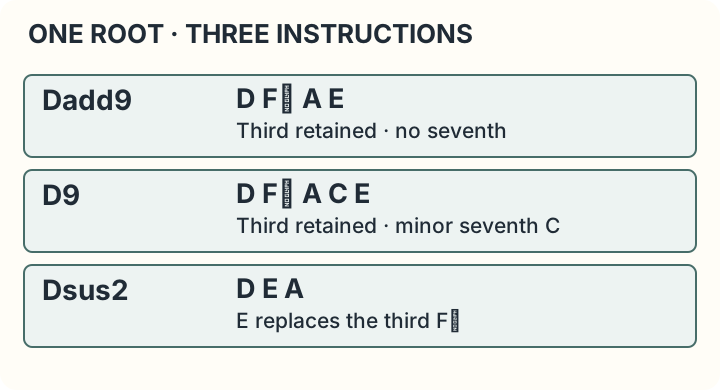
| Symbol | Parser result | One example |
|---|---|---|
| Dadd9 | D major plus E; no seventh | D3–F♯3–A3–E4 |
| D9 | D7 plus E | D3–F♯3–A3–C4–E4 |
| Dsus2 | D–E–A; no third | D3–E3–A3 |
The crucial Dadd9 versus Dsus2 check is F♯ present or replaced? Both contain the pitch class E. Moving E up an octave does not restore the missing third. The Dadd9 versus D9 check is C absent or included? Do not treat the shorter symbol D9 as an abbreviation for Dadd9.
Write Dsus4 beside the table: D–G–A. In this elementary parsing scope it replaces F♯ with G; it does not add G while keeping F♯. The word sus by itself commonly means sus4. The symbol does not require you to invent a resolution that the music has not supplied. Source: sus conventions.
Set the seventh before altering the ninth
Parse D7(♭9). First write D7 as D–F♯–A–C. Next find the unaltered ninth E, then lower it a semitone to E♭. The complete nominal collection is D–F♯–A–C–E♭. The flat changes the ninth; it changes neither the root nor the seventh. Sharp/flat extension signs adjust the default interval. Source: interval quality and alterations.
Check the seventh independently: D up to C is ten semitones, a minor seventh. If you wrote C♯, you changed the seventh quality. Check the altered ninth by letter as well: its letter must be E. D♯ would hit the same equal-tempered key as E♭ but would obscure the requested ninth spelling. For that distinction, revisit interval number and quality.
Now parse Dmaj9. Its base is Dmaj7, so its members are D–F♯–A–C♯–E. Circle the one difference from D9: C♯ instead of C. “Major” in this extension label is doing work; do not ignore it because the base triad was already major.
Keep the symbol separate from a particular voicing
Compare three original realisations of Dadd9: D3–F♯3–A3–E4, D2–A2–F♯3–E4, and D3–A3–D4–F♯4–E5. Each retains D, F♯, A and E, with D in the bass. Spacing and doubling differ. The third version doubles D; that does not introduce a new pitch class. These examples are note specifications, not recommended fingerings.
A slash adds a bass instruction: Dadd9/F♯ can be realised as F♯2–D3–A3–E4. Its base collection is unchanged but its lowest note is now F♯. Review root versus bass if those seem contradictory. A slash bass need not always belong to the base chord. Source: bass notes.
Practical jazz voicings may omit a fifth, and a bassist may supply a root absent from another player's part. Those choices depend on the arrangement. Source: Open Music Theory, omitting notes. Our parser exercises retain every nominal member. Do not use “players omit notes” to erase the defining third, seventh or altered ninth and then assume the written evidence still distinguishes these symbols. If a part omits something, record what is omitted and whether another part supplies it.
A chord symbol alone does not specify every octave, doubling, rhythm, duration or fingering. A complete performance instruction needs the rest of the chart and its context. Writing a collection correctly is one task; making it fit an instrument is another.
Check your reading without changing the rules
- Write all nominal members of Eadd9, E9 and Esus2.
- Parse A7(♭9), identifying the seventh before the alteration.
- Which of these is a genuinely different collection from Dadd9: D2–A2–F♯3–E4 or D3–F♯3–A3–C4–E4?
- Does moving D3–F♯3–A3–E4 up one octave prescribe a new chord symbol?
Check the parser answers
- Eadd9: E–G♯–B–F♯. E9: E–G♯–B–D–F♯. Esus2: E–F♯–B. The first retains G♯ without D; the second adds D; the third replaces G♯.
- A–C♯–E–G–B♭. G is the minor seventh; B♭ is the lowered ninth.
- The second collection adds C and matches D9 in our full-member exercise. The first is another Dadd9 voicing.
- No. D4–F♯4–A4–E5 has the same spelled pitch classes, with D still lowest.
Download the symbol parser worksheet and answer key. For each new chart symbol, retain separate columns for its nominal collection and your proposed realisation. That makes an uncertain abbreviation visible before it becomes an unexplained missing note.
Sources and scope
Checked 3 October 2026. The exercises, checklists and planning examples are original learning aids, not measured market data or guarantees of learning outcomes.
- Open Music Theory 2e: Chord Symbols, Humanities LibreTexts edition
Republished OMT chapter, attributed there to its VIVA source. Freshly read body supports defaults, add/extension distinction, altered extensions, bass and notation variation. Original VIVA chapter was inaccessible during this check. Our D-, E- and A-root fixtures are original.
- Music Theory for the 21st-Century Classroom: Simple “Sus” Chords
Section 6.5: simple sus2/sus4 replacement of the third. This guide does not extend that elementary rule to every advanced jazz sus voicing.
- Open Music Theory: Jazz Voicings
Omitting Notes section supports context-dependent fifth/root omissions. No omission is silently applied to our full-member parser answer keys; no instrumental playability test is claimed.
About this guide
SwarShala publishes practical information to help learners compare independent music providers. This guide was prepared with AI assistance and primary-source research. No named educator, teaching credential or independent expert review is claimed.
Editorial standards · Report an error or outdated information