Turn Trinity technical-work requirements into a coverage sheet
Separate required sections, alternatives, candidate choices, examiner selections and memory rules before turning a syllabus into a practice checklist.
By SwarShala publishing desk · Published · 5 min read
Sources checked . AI-assisted; no independent expert review claimed.
The practical starting point
A coverage sheet records what must be prepared and who chooses what is presented. Repetitions belong in a separate practice log; they cannot compensate for an omitted compulsory section.
Map the requirements before counting repetitions
“I practised scales every day” does not establish that every required item has been prepared. A coverage sheet asks a narrower question: does your plan contain the complete set required for your exam? It can expose an omitted group before you spend more time on the items you already know.
Start with the exact instrument, grade and format from your syllabus and book register. Trinity’s general guidance distinguishes face-to-face Classical & Jazz exams and the digital Technical Work pathway from digital Repertoire-only exams. Its options vary by instrument. Source: technical-work guidance. Do not transfer a familiar choice from one instrument or pathway into another.
Keep this task on paper: it maps documents. It does not prescribe hand position, repetitions, physical technique or a practice speed. Those decisions need a separate teaching plan appropriate to the learner.
Use columns that preserve the logic
- Requirement and source: section, item or group, plus the syllabus page.
- Preparation rule: all items, one from each group, one complete alternative, or another precisely stated instruction.
- Selection: who chooses, and whether the choice happens during preparation or at assessment.
- Memory or music: the rule for this row, not a guess borrowed from an adjacent row.
- Evidence and next action: exact chosen items, book location and any unresolved requirement.
The words and and or do different jobs. “A and either B or C” means A remains compulsory whichever alternative you choose. A row labelled “choice” without the selection rule loses that distinction. Likewise, “prepare three; perform two” does not authorise preparing only two.
Use “requirements mapped”, “item not yet located” and “question unresolved” as document statuses. Keep “played accurately today” in a separate practice log. A correctly completed coverage sheet is not a certificate of performance readiness.
Check one actual example: Grade 1 piano, face-to-face
The linked Piano syllabus, online edition February 2026, sets out Grade 1 face-to-face technical work on printed pages 100–101. All three sections are prepared: scales, broken chords and exercises. The first two are from memory. For exercises, music may be used: prepare one from each of three groups; the candidate selects the first to perform and the examiner selects another of the two remaining. Source: current piano syllabus.
| Section | Coverage entry | Selection / memory | Document action |
|---|---|---|---|
| Scales | Map the complete specified list | Examiner selects; from memory | Record each listed requirement and any stated candidate option |
| Broken chords | Map the complete specified list | Examiner selects; from memory | Locate each item; do not treat this section as interchangeable with scales |
| Exercises | One chosen item in each of Groups 1, 2 and 3 | Candidate first, then examiner; music permitted | Write all three item identifiers and their book locations |
The table intentionally leaves the individual scale and exercise titles to your current syllabus. Its purpose is to preserve coverage and selection, not reproduce the complete exam requirements. If you switch to digital assessment, create a fresh mapping from the digital section rather than merely changing the table heading.
Find the missing compulsory item in a fictional plan
This logic exercise is invented and is not a Trinity syllabus. Its rules are: prepare compulsory item C; also select exactly one complete route, A or B. Route A contains A1 and A2, both from memory. Route B contains B1 and B2, for which music may be used. The learner chooses the route in advance; an assessor selects one item from the prepared route. C is presented in every case, with music permitted.
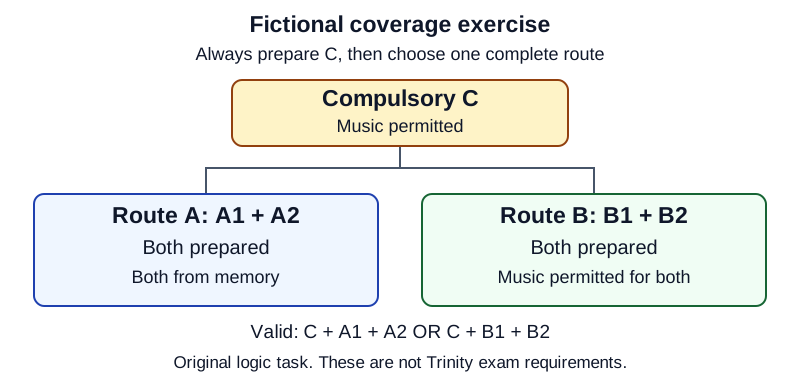
- Leela records B1 and B2, chooses Route B and marks the sheet complete. What is missing?
- Dev records C, A1 and B2. Why is the count of three items insufficient?
- Write one complete valid plan and its memory rule.
Check the coverage, not the number of ticks
1: C is absent. B is a valid route but cannot replace the compulsory item. 2: Dev has mixed routes. Neither A1+A2 nor B1+B2 is fully prepared. 3: C+B1+B2 is valid and music is permitted for these stipulated items. Alternatively C+A1+A2 is valid, with A1 and A2 from memory and music permitted for C. The assessor’s eventual selection does not reduce the preparation requirement.
Check the sheet in both directions
Download the coverage template and fictional answer key (plain text). First read each syllabus requirement and find its row. Then read each row and find the requirement that justifies it. This catches both omissions and invented obligations.
If a sentence leaves you unsure who selects an item, preserve that uncertainty as a question. Do not fill the box with the most convenient answer. Add the source page and exact point needing clarification to your next lesson discussion or official enquiry.
After coverage is checked, choose a small practice task and record its result in a manageable practice routine. Review the sheet when your exam format, grade or governing document changes; ordinary daily practice does not require rebuilding the document map.
Sources and scope
Checked 3 October 2026. The exercises, checklists and planning examples are original learning aids, not measured market data or guarantees of learning outcomes.
- Trinity College London: Choosing Technical Work, Supporting Tests & Session Skills
Official format scope and instrument-dependent technical-work options. The fictional C/A/B route is an original logic exercise.
- Trinity College London: Piano syllabus from 2023, online edition February 2026
Printed pages 100–101: Grade 1 face-to-face preparation, selection and memory rules. The article maps one example and does not replace the complete syllabus.
About this guide
SwarShala publishes practical information to help learners compare independent music providers. This guide was prepared with AI assistance and primary-source research. No named educator, teaching credential or independent expert review is claimed.
Editorial standards · Report an error or outdated information