Prepare Trinity musical knowledge from the score you actually play
Annotate an original four-bar miniature, distinguish score evidence from instrument knowledge and historical sources, and practise explaining what supports each answer.
By SwarShala publishing desk · Published · 5 min read
Sources checked . AI-assisted; no independent expert review claimed.
The practical starting point
For each explanation, identify its evidence: a specific score location, knowledge of the instrument, or a reliable external source. A confident story is not a substitute for that evidence.
Check the test you are preparing for
Trinity describes musical knowledge as a face-to-face supporting-test option through Grade 5, with instrument and grade parameters in the applicable syllabus. It connects notation, the instrument and the music being performed. Source: supporting tests. This guide teaches an evidence habit; its practice questions are original and are not a predicted examiner script.
For the piano example checked here, printed pages 88–89 of the February 2026 online syllabus give cumulative parameters. Initial includes basic notation; Grade 1 adds note values and explanations of key/time signatures. Later grades add further topics. Exam scores must not contain annotations that help answer the questions. Source: piano musical-knowledge parameters.
Use a separate study sheet while learning, and follow the current exam rules for the score you take. Choose the rows relevant to your actual grade and instrument. Our instrument and historical examples below demonstrate kinds of evidence; they do not add invented requirements to an Initial or Grade 1 piano test.
Read the original miniature “Window Steps”
This four-bar teaching melody was created for SwarShala in 2026. It is a single treble-clef line for score-reading, not Trinity repertoire or a full exam piece. Middle C is C4. It uses 4/4, no key-signature accidentals and no local accidentals. The clef is identified by a text label in the diagram.
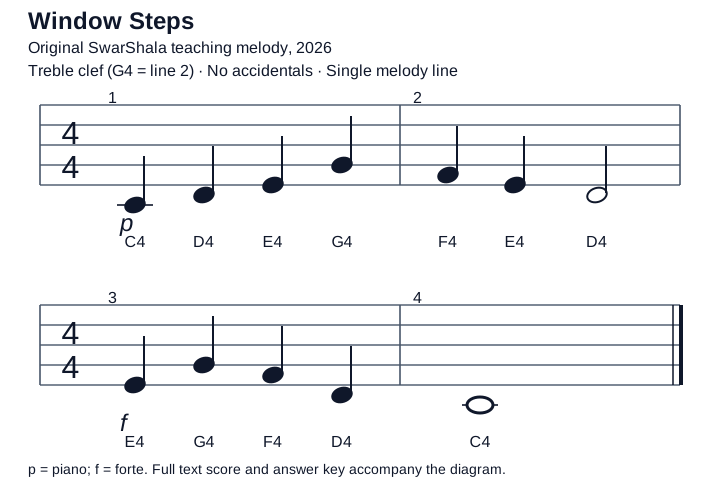
Mark three observations on your study sheet: where the dynamic changes, which bar contains a minim, and where the opening and ending pitch agree. A useful explanation is “the change to forte is printed at bar 3”, rather than “the whole tune is loud”. Keep the statement attached to its location.
If note positions are unfamiliar, use treble-clef landmarks before tackling the questions. A diagram’s pitch labels and the text score should lead to the same notes.
Separate three kinds of explanation
| Question | Evidence kind | Useful answer form |
|---|---|---|
| Where does the printed dynamic change? | Score reading | Point to bar 3 and identify f; compare it with p at the start |
| How does an acoustic piano begin and transmit a note’s sound? | Instrument explanation | Name the mechanism and cite a reliable instrument source; do not infer it from noteheads |
| Who developed the early piano, and approximately when? | External historical context | Give the source, a carefully stated date and the limits of what it establishes |
For the instrument row, Yamaha explains that hammers strike strings and vibrations pass through bridges to the soundboard. Source: piano sound-producing mechanism. This is an acoustic-piano explanation; it is not an account of every electronic keyboard. The printed melody does not prove the mechanism, and we have not performed a physical demonstration here.
For a small contextual example, Yamaha attributes the piano’s development to Bartolomeo Cristofori around 1700. Source: the piano’s origins. That is background about the instrument. It does not date “Window Steps”, identify this melody as Baroque repertoire, or establish how an unrelated piece should be interpreted. For a real repertoire work, consult a reliable edition or archive for its own composer, date and circumstances.
Answer five questions with a location or source
- Explain the 4/4 time signature for this exercise, then verify the duration of bar 2.
- Identify the final note’s letter, octave and value.
- Locate the printed dynamic contrast. Does the score specify an exact volume measurement?
- Classify these claims: “bar 3 begins forte”; “an acoustic piano uses hammers”; “Cristofori developed the early piano around 1700”.
- A learner says the melody must have been composed around 1700 because its instrument has that history. What does the evidence actually establish?
Open the checked reasoning
- Four crotchet beats per complete bar. Bar 2 contains 1+1+2=4 crotchet beats: F4 crotchet, E4 crotchet, D4 minim.
- C4, a semibreve; in this metre it occupies four crotchet beats. It lies on the first ledger line below treble.
- p at bar 1 and f at bar 3. The score gives relative dynamic instructions, with no decibel value or measured performance supplied.
- Respectively: score reading, instrument explanation, external historical context. Each needs its corresponding evidence, not a single catch-all “music facts” answer.
- The source establishes a contextual claim about the piano. The miniature’s stated origin is SwarShala, 2026. Instrument history cannot date an arbitrary score.
Make a sheet for one of your own pieces
Download the score-evidence sheet, text miniature and answers (plain text). Select one printed sign, one pattern you can explain and one genuine question about the piece. Record the bar number for score observations and a source for contextual claims. If you cannot support an answer, leave an explicit question instead of inventing a composer anecdote.
When a lesson calls for demonstrating a musical feature, record what you actually played or heard after doing it. Reading the sheet alone is not evidence that the demonstration succeeded. Keep the worksheet’s completed reading tasks separate from performance tasks still to practise.
Bring a focused uncertainty to your teacher: “I can identify these notes, but I cannot explain why this key label fits the passage.” Use our theory error-review method to turn a wrong explanation into a specific new task.
Sources and scope
Checked 3 October 2026. The exercises, checklists and planning examples are original learning aids, not measured market data or guarantees of learning outcomes.
- Trinity College London: Supporting tests for face-to-face exams
Musical-knowledge purpose, availability through Grade 5 and requirement to consult the instrument syllabus.
- Trinity College London: Piano syllabus from 2023, online edition February 2026
Printed pages 88–89: cumulative musical-knowledge parameters and exam-score annotation restriction. Original exercises are not examiner scripts.
- Yamaha Musical Instrument Guide: The Sound-Producing Mechanism
Manufacturer explanation of acoustic-piano hammers, strings, bridges and soundboard; no physical trial was undertaken for this guide.
- Yamaha Musical Instrument Guide: The Story of the Piano’s Invention
Small instrument-context example: attribution to Cristofori around 1700. Not evidence about the date or period of the original teaching melody.
About this guide
SwarShala publishes practical information to help learners compare independent music providers. This guide was prepared with AI assistance and primary-source research. No named educator, teaching credential or independent expert review is claimed.
Editorial standards · Report an error or outdated information