Borrow a chord from parallel minor and show what changed
Change F major to F minor inside an original C-major phrase, spell ♭VI in D major, and distinguish borrowing from a secondary-dominant target.
By SwarShala publishing desk · Published · 6 min read
Sources checked . AI-assisted; no independent expert review claimed.
The practical starting point
Keep the prevailing tonic visible, identify the altered chord member and spell the borrowed chord. A borrowed chord is evidence of a local change; it does not by itself establish a new key.
Borrow from the parallel collection
Mode mixture commonly brings a chord from parallel minor into a major-key setting. Parallel keys share a tonic: C major and C minor both centre on C. Lowered scale degrees 3, 6 and 7 supply common differences. Source: Puget Sound, mode mixture. Compare complete collections in relative versus parallel keys if that relationship is new.
Here C major is the supplied prevailing key. Its fourth-degree triad is F–A–C, labelled IV. C natural minor contains A♭, so its fourth-degree triad is F–A♭–C, labelled iv. To borrow that chord, keep F and C and lower only A to A♭. The chord root stays on degree 4; its third changes from major to minor.
Our notation uses uppercase for a major triad and lowercase for a minor triad. A ♭ before a numeral lowers the root relative to the prevailing major scale. That is different from an accidental on a chord member. Review Roman-numeral root and quality before adding chromatic prefixes.
Compare two complete harmony sketches
These original eight-bar sketches specify one chord at the start of every 4/4 bar, held for four quarter-note beats. C major is supplied. Read each row straight through and stop after bar 8; no repeat or extra pickup is implied. Version B changes only bar 4. This is a paper harmony exercise, not a claim about a recorded performance.
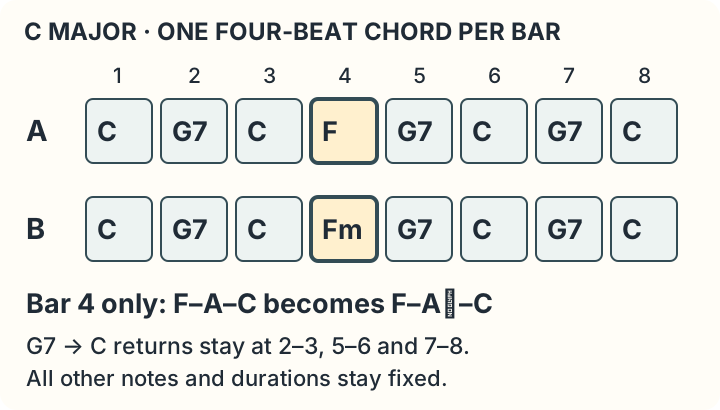
| Bars | Version A | Version B |
|---|---|---|
| 1, 3, 6, 8 | C: C3–E3–G3–C4 | Unchanged |
| 2, 5, 7 | G7: G2–B2–D3–F3 | Unchanged |
| 4 | F: F2–A2–C3–F3 | Fm: F2–A♭2–C3–F3 |
Version A is I–V7–I–IV–V7–I–V7–I. Version B is I–V7–I–iv–V7–I–V7–I. The repeated G7–C returns, C-major chords containing E natural, and final return to C support the intended continuing C-major context. There is no separate sustained passage establishing C minor. Calling bar 4 iv describes this local change without declaring a new tonic.
Mark the changed pitch as A♭, not G♯: it is still the third of an F chord and the lowered sixth degree of the C-major reference. The chord spells F–A♭–C, not a new triad rooted on A♭. Count the unchanged notes before considering any change in expressive effect. No particular emotion follows automatically from a chord label.
Build ♭VI in D major from the parallel minor
Write the two collections: D major is D–E–F♯–G–A–B–C♯; D natural minor is D–E–F–G–A–B♭–C. Degree 6 of D major is B. Lower its root by one semitone for ♭VI, giving B♭, then build the major triad: B♭–D–F. These are degrees 6, 1 and 3 of the parallel natural-minor collection.
The ♭ changes the root's position relative to D major, while uppercase VI specifies major quality. Do not write B♭–D–F♯: B♭ to F♯ is an augmented fifth, so that collection is not the requested major triad. The original D-major key signature is a reference for the analysis, not a command to retain F♯ in every chromatic chord.
A Roman prefix is relative, not a promise that the resulting note name contains a flat. Source: analysing and writing borrowed chords. Try ♭VI in E major: degree 6 is C♯; lowering it gives C natural. The chord is C–E–G, with no written flats. Both this chord and D major's B♭–D–F follow the same operation.
For another paper phrase, use supplied D major and one four-beat chord per bar: D | G | B♭ | A7 | D. Label it I–IV–♭VI–V7–I. The final A7 is A–C♯–E–G and returns to D–F♯–A. Keep that surrounding return in your analysis; the isolated B♭ chord would not establish the whole phrase's key.
Contrast a borrowed chord with a secondary dominant
A secondary dominant is a major triad or dominant seventh directed toward another chord as a local tonic. A slash in its Roman label names that target. Source: Puget Sound, tonicization. This is a different question from identifying a chord borrowed from the parallel mode.
Compare two original C-major snippets, each with one four-beat chord per bar: C | Fm | G7 | C and C | D7 | G | G7 | C. First spell their unusual chords. Fm is F–A♭–C, available in C natural minor. D7 is D–F♯–A–C, with a major third F♯ that is absent from C natural minor.
In the first snippet, label Fm iv: it borrows the minor subdominant and is followed by G7–C. This label names no secondary tonic target. In the second, D7 leads to G and is V7/V, “dominant seventh of the dominant”: G is the stated local target. The continuing G7–C return retains the larger C-major setting. A local target is not automatically a lasting modulation.
Do not label every accidental “borrowing”. Ask two separate questions: does the proposed collection fit the parallel mode, and does the actual progression support an applied dominant and its target? Those checks explain why A♭ in Fm and F♯ in D7 need different accounts in these snippets. They do not establish a universal classification from one accidental without context.
Make one controlled change and explain it
- Write every changed pitch when version A's bar 4 becomes version B. What stays fixed?
- In supplied G major, replace IV with borrowed iv. Spell both chords.
- Build ♭VI in D major and E major. Why does only one root have a flat in its name?
- In C | D7 | G | G7 | C, name D7's target and explain why “borrowed from C natural minor” fails.
Check the borrowing answers
- A2 becomes A♭2. F2, C3 and F3, the duration, chord position and all seven other bars stay fixed.
- IV is C–E–G; iv is C–E♭–G. E♭ is lowered degree 6 relative to G major.
- D major: B♭–D–F. E major: C–E–G. Their original sixth degrees are B and C♯; lowering each by a semitone produces different accidental spellings.
- G is the local target, giving V7/V. D7 contains F♯, which C natural minor does not; its major-third spelling and actual move to G support the applied-dominant reading.
Download the before-and-after phrase worksheet. Record the supplied key, complete phrase, changed member, Roman label and surrounding return. If only a chord fragment is available, write down that missing context instead of claiming a confirmed tonic change.
Sources and scope
Checked 3 October 2026. The exercises, checklists and planning examples are original learning aids, not measured market data or guarantees of learning outcomes.
- Music Theory for the 21st-Century Classroom: Mode Mixture
Section 19.1: common parallel-minor borrowing in major and lowered degrees 3, 6 and 7. No universal emotional interpretation is adopted. Both eight-bar harmony sketches and their registered pitches are original.
- Music Theory for the 21st-Century Classroom: Analyzing and Writing Borrowed Chords
Section 19.3: root, quality and inversion labels; accidental prefixes relative to the prevailing key. The original D- and E-major exercises distinguish relative lowering from literal flat note names.
- Music Theory for the 21st-Century Classroom: Tonicization
Section 17.2 supplies the dedicated source for the required secondary-dominant contrast: dominant-quality chords and their non-tonic targets. The original snippets support only the stated local readings, not a universal key-detection rule.
About this guide
SwarShala publishes practical information to help learners compare independent music providers. This guide was prepared with AI assistance and primary-source research. No named educator, teaching credential or independent expert review is claimed.
Editorial standards · Report an error or outdated information