Identify passing, neighbour and suspension tones in context
Compare the same middle pitch in two melodies, then trace a prepared note across a chord change using original timed examples and a worksheet.
By SwarShala publishing desk · Published · 6 min read
Sources checked . AI-assisted; no independent expert review claimed.
The practical starting point
Check the chord at that moment, then the note before and after. A pitch name, accidental or tie by itself cannot identify a nonchord-tone pattern.
Ask three questions before choosing a label
A nonchord tone is outside the supporting chord. In the Western tonal examples here, a passing tone moves by step between chord tones in the same direction; a neighbour tone steps away and returns. A suspension retains a prepared note into a dissonance and then resolves downward by step. These labels describe motion in context. Source: introductory classification table; detailed suspension treatment.
- What chord supports this exact moment? Write its members and mark any chord change during a held note.
- Where did this voice come from? Record the preceding pitch and whether it steps, leaps or stays.
- Where does this voice go next? Compare its departure with its approach, including the harmony at the destination.
Use the questions in order. The same D can be a chord tone over D minor and a nonchord tone over C major. Even after membership is settled, D alone cannot tell you whether the melody passed through it or returned from it. If the harmony or adjacent notes are missing, record “insufficient context” instead of guessing.
These are written classification exercises, not a complete catalogue of melodic decoration. Review triad members and written intervals first if those checks are unfamiliar.
Classify the same D in two complete one-bar melodies
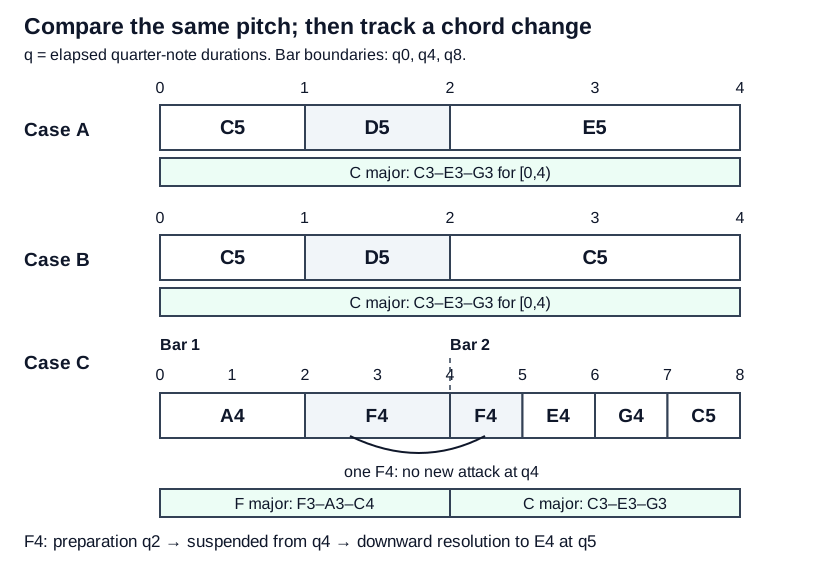
Both cases are in C major and 4/4. The accompaniment holds C3–E3–G3 throughout the bar. Let q count elapsed quarter-note durations from zero: the bar starts at q=0 and ends at q=4. C4 is middle C; C5 is the next C above it. An interval such as [0,1) includes its starting instant and ends immediately before the next event.
| Elapsed interval | Duration | Case A melody | Case B melody |
|---|---|---|---|
| [0,1) | Quarter note | C5 | C5 |
| [1,2) | Quarter note | D5 | D5 |
| [2,4) | Half note | E5 | C5 |
Before opening the answer, classify D5 in each case. List the supporting chord, the preceding note and the following note. “D is not in C major” is ambiguous: does that mean the chord or the scale?
Check both D5 classifications
C major's chord members are C, E and G, so D5 is outside the chord in both cases. In A, C5–D5–E5 steps upward twice between chord tones: D5 is a passing tone. In B, C5–D5–C5 steps up and back to its starting chord tone: D5 is an upper neighbour tone. Both Ds belong to the C-major scale. Neither needs a chromatic accidental to be a nonchord tone.
The last notes last two quarters; they are not two separate attacks. If you rewrite the cases in staff notation, use a half note at q=2. Use the duration guide to check that each bar totals four quarters.
Track a suspension through three stages
Case C is a separate two-bar example in C major, still in 4/4. The first bar, [0,4), holds F3–A3–C4, an F-major chord. Exactly at q=4, the accompaniment changes to C3–E3–G3 and holds that C-major chord until q=8. The melody below is complete.
| Interval | Melody | Written duration | Harmony |
|---|---|---|---|
| [0,2) | A4 | Half note | F major |
| [2,4) | F4 | Half note, tied onward | F major |
| [4,5) | F4 continued | Quarter note tied from preceding F4; no new attack | C major |
| [5,6) | E4 | Quarter note | C major |
| [6,7) | G4 | Quarter note | C major |
| [7,8) | C5 | Quarter note | C major |
Mark three moments: preparation at q=2, the chord change at q=4, and resolution at q=5. At which of those moments does F first become a nonchord tone? Why is the note at q=5 relevant?
Check preparation, dissonance and resolution
- At q=2, F4 is a member of F major. It prepares the held note.
- At q=4, the harmony changes while F4 continues. F is outside C–E–G, and its fourth above the C pitch class supplies the suspension's dissonance on the new bar's downbeat.
- At q=5, F4 moves down by step to E4, a C-major chord tone. This completes the suspension.
The bass is C3, so the literal written intervals are an eleventh and a tenth. Reducing them by an octave gives the conventional 4–3 suspension label. The numbers describe the suspended note and its resolution above the bass, not two chord roots.
The source distinguishes preparation, suspension and resolution, and shows preparations both with and without a tie. A tie is therefore useful evidence of continuation, not the entire definition. Source: Suspension, including compound intervals.
Reject two tempting shortcuts
“Every tied note is a suspension.” Consider this complete counterexample: C3–E3–G3 supports [0,4), E3–G3–B3 supports [4,8), and a G4 whole note is tied to another G4 whole note across the boundary. G belongs to both supplied chords. There is no nonchord dissonance at q=4 and no downward resolution in this melody, so this tie does not establish a suspension.
“Every accidental is a nonchord tone.” Suppose a passage's stated key is C major, but its supplied chord at one moment is D major, D–F-sharp–A. F-sharp is chromatic relative to that key and still belongs to the current chord. Conversely, D-natural in Cases A and B is diatonic and outside its chord. Key membership and chord membership answer different questions.
A lead-sheet symbol containing “sus” describes a chord's members; it does not alone supply this three-stage melodic history. Keep the surrounding events when making a suspension analysis. Likewise, an upward resolution is not the downward pattern taught in Case C. Do not force every outside note into one of this guide's three categories.
Classify and repair before checking the key
For Questions 1 and 2, the key is C major, the metre is 4/4, and F3–A3–C4 sounds for [0,4). The first two melody notes last one quarter each; the third lasts two quarters.
- A4–G4–F4: classify G4 and name both directions of motion.
- A4–G4–A4: classify G4. What changed from Question 1?
- A learner labels the whole F4 duration [2,5) in Case C “nonchord suspension”. Repair the time interval, then give the preparation and resolution coordinates.
- A cropped score shows only D5 over C major, with no preceding or following melody. Can you choose passing versus neighbour?
Check the independent answers
- Passing tone: G is outside F–A–C, and A–G–F steps down twice between chord tones.
- Lower neighbour: A–G–A steps down and back up to A. The departure changed; the middle pitch and harmony did not.
- Only [4,5) is the suspended nonchord stage. F4 is prepared as a chord tone at q=2 under F major; the C-major change at q=4 makes it nonchord; E4 at q=5 resolves it downward.
- No. Its nonchord membership is established, but its approach and departure are missing.
Download the melody-and-harmony worksheet with separate answer key. For a passage of your own, first write a chord timeline and complete note durations. If you cannot establish the harmony, settle that before assigning decoration labels.
Sources and scope
Checked 3 October 2026. The exercises, checklists and planning examples are original learning aids, not measured market data or guarantees of learning outcomes.
- Music Theory for the 21st-Century Classroom: Introduction to Non-Chord Tones
Section 10.1 classification table and diatonic/chromatic terminology. All timed melody cases, counterexamples and questions here are original.
- Music Theory for the 21st-Century Classroom: Suspension
Section 10.9: preparation, accented dissonance, downward resolution, tied and untied preparation, and reduced compound interval labels. The lesson uses one simple upper-voice 4–3 case.
About this guide
SwarShala publishes practical information to help learners compare independent music providers. This guide was prepared with AI assistance and primary-source research. No named educator, teaching credential or independent expert review is claimed.
Editorial standards · Report an error or outdated information