Read repeats, endings and D.C./D.S. directions as a route
Trace original bar maps, separate first and return passes, and check repeat endings, Fine and Coda without losing your place.
By SwarShala publishing desk · Published · 5 min read
Sources checked . AI-assisted; no independent expert review claimed.
The practical starting point
Write the bars in their playing order. Track the current pass as well as the bar number: a sign you pass on the first journey may become active after a D.C. or D.S. return.
Identify the instruction before following it
A score can print a passage once and ask you to visit it more than once. In Western staff notation, repeat barlines mark a repeated section; numbered ending brackets identify the ending for a particular pass. D.C. means return to the beginning; D.S. means return to the segno sign. “Al Fine” specifies the eventual stopping point; “al Coda” specifies a later jump to a closing section. Source: Open Music Theory, structural features.
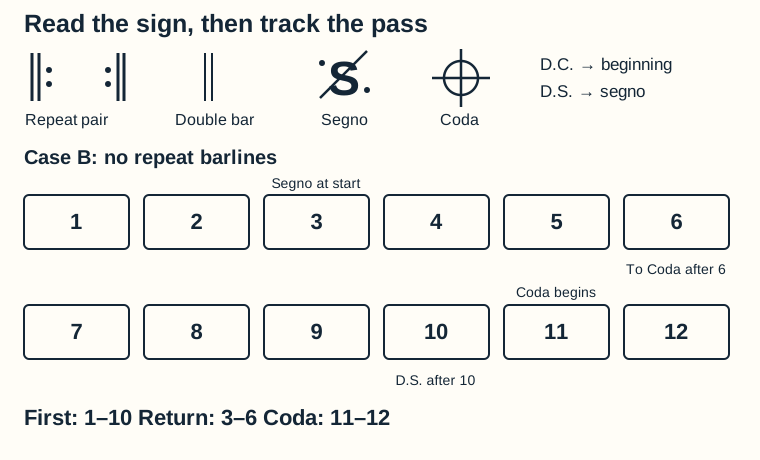
A plain double bar separates sections; it does not by itself send you backwards. Find both the departure and destination of every jump before playing. Circle a destination lightly on your own working copy if that helps. Do not change an ensemble's agreed markings without checking them.
First solve a repeat with two endings
Use this original six-bar case. The opening repeat is immediately before bar 1. Bars 1–3 are shared. The bracket labelled 1 covers bar 4, which ends with a backward repeat. The bracket labelled 2 covers bar 5. Bar 6 follows normally and ends the example. Play the repeated section twice in total.
- First pass: play 1, 2, 3 and the first ending, 4.
- At the repeat after 4, return to 1.
- Second pass: play 1, 2, 3; skip the whole first-ending bracket, and play 5.
- Continue to 6 and stop.
The complete ledger is 1, 2, 3, 4, 1, 2, 3, 5, 6: nine played bars from six printed bars. If you wrote 4 and 5 on the second pass, you played both alternatives. If you jumped straight from 4 to 5 on the first pass, you missed the repeat. Say the bar numbers while tracing the map before adding pitches or rhythm.
Then solve D.S. al Coda without repeat barlines
The twelve-box diagram supplies a separate case. The segno is at the start of bar 3. “To Coda” is after bar 6. “D.S. al Coda” is after bar 10. The Coda begins at bar 11 and ends after bar 12. There are no repeat barlines in this case.
| Journey | Bars visited | Action at the end |
|---|---|---|
| First pass | 1 through 10 | Return to the segno at 3 |
| Return pass | 3, 4, 5, 6 | Take the now-active To Coda jump |
| Coda | 11, 12 | Stop |
Its full route is 1, 2, 3, 4, 5, 6, 7, 8, 9, 10, 3, 4, 5, 6, 11, 12. The To Coda instruction is passed on the first journey and taken on the return. Bar 6 is played before the jump because this example places the instruction after it. Do not jump at its start.
Keep two notes in your ledger: “current bar” and “first/return/Coda”. Bar 6 alone cannot tell you what happens next; its current state can. The example supplies a complete navigation contract, not a rule about every publisher's layout.
Check what changes with D.C. and Fine
Try this independent five-bar case: Fine is after bar 3 and D.C. al Fine is after bar 5; there are no repeat barlines. Write the route before opening the answer.
Check the D.C. al Fine route
1, 2, 3, 4, 5, 1, 2, 3, then stop. D.C. returns to the beginning, so it goes to 1. Fine becomes the stopping point on that return; it did not end the first pass.
For an actual score, also read any words governing repeats after the return. Do not assume that the repeated section must always be played twice again. Ask about an ambiguous edition before rehearsal and record the agreed route.
Combine the instructions with an explicit return rule
Case C modifies the twelve-bar Case B: add an opening repeat before 4 and a backward repeat after 5. On the first journey, play 4–5 twice. On the D.S. return, do not take that repeat. Every other Case B marking stays in place. Write all visited bars, not only the jump destinations.
Check the combined route
1, 2, 3, 4, 5, 4, 5, 6, 7, 8, 9, 10, 3, 4, 5, 6, 11, 12. That is eighteen played bars. The return contains 4 and 5 once each, then bar 6 sends you to 11.
A proposed answer ends “…10, 3, 4, 5, 11, 12”. Locate the error: it has skipped bar 6 on the return. Another answer includes “…10, 3, 4, 5, 4, 5, 6…”. It has ignored the stated no-repeat-on-return rule. These are different wrong turns, so mark the exact decision that needs repair.
Download the route worksheet and answer key. Transfer the same ledger method to a short passage you are learning, then use the first sight-reading workflow once the route is settled. For note identification, start with treble and bass clef landmarks.
Sources and scope
Checked 3 October 2026. The exercises, checklists and planning examples are original learning aids, not measured market data or guarantees of learning outcomes.
- Open Music Theory: Other Aspects of Notation
Structural Features section: repeats, numbered endings, D.C., D.S., Fine and Coda. All numbered routes and the explicit repeat-on-return rules here are original exercises.
About this guide
SwarShala publishes practical information to help learners compare independent music providers. This guide was prepared with AI assistance and primary-source research. No named educator, teaching credential or independent expert review is claimed.
Editorial standards · Report an error or outdated information