Count unequal beat groups and changes of metre
Compare 2+3 with 3+2, map a 7/8 bar, and carry a declared steady eighth-note unit through an original changing-metre exercise.
By SwarShala publishing desk · Published · 5 min read
Sources checked . AI-assisted; no independent expert review claimed.
The practical starting point
Separate the equal small units from the unequal groups. In this exercise the eighth-note duration stays constant; the group lengths and bar lengths change.
Read the grouping as well as the signature
Five eighth-note units can be grouped 2+3 or 3+2. Both total five, but their group starts differ. A signature such as 5/8 does not, by itself, choose between them. Inspect beaming, an additive signature or an explicit performance direction. Unequal grouping is often called asymmetrical metre; terminology varies. Source: Open Music Theory, asymmetrical metre.
This guide teaches a small Western-notation reading task. It does not survey the rhythmic systems of the world or claim that unequal grouping originated in twentieth-century Western music. If you need a refresher on regular divisions first, read simple and compound metre.
For every exercise below, one small box is exactly one eighth-note duration. Keep those small durations equal. A group containing three boxes lasts longer than a group containing two; do not make the boxes in the shorter group slower to equalise the groups.
Compare two arrangements of the same five units
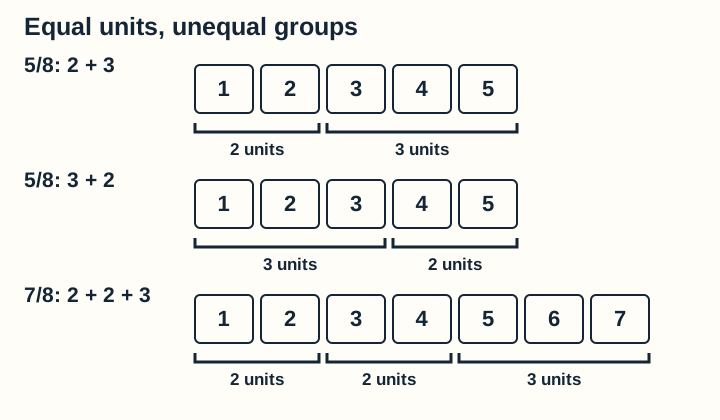
For 2+3, point evenly and say “ONE two | ONE two three”. For 3+2, say “ONE two three | ONE two”. These are suggested local counting syllables. The repeated word ONE marks a group start, not a new bar. The bar begins only at the first box of each complete five-unit row.
First point through each row without adding any note. Next, say a short “ta” only at group starts while continuing to point at every box. Pattern A starts sounds at units 1 and 3; pattern B starts them at units 1 and 4. The patterns have equal bar lengths and the same number of attacks, but different placement. No sustain or instrument articulation is prescribed by this onset exercise.
A useful paper check is to number the boxes 1–5 continuously underneath the group counts. You can then see why “ONE” occurs at different numbered boxes without changing the size of a box. If the two rows seem identical, check the boundary after unit 2 versus after unit 3.
Build and check a 2+2+3 bar
Draw seven equal boxes and place boundaries after boxes 2 and 4. The groups contain 2, 2 and 3 eighth-note units. Point while saying “ONE two | ONE two | ONE two three”. Group starts occur at units 1, 3 and 5; the next bar starts after unit 7.
Now keep the same seven-box row but regroup it as 3+2+2. Put boundaries after boxes 3 and 5. Its starts are 1, 4 and 6. This new task changes grouping, not total duration. Neither arrangement is the universal meaning of 7/8; the music must establish the intended arrangement.
To diagnose an added unit, write the groups as an addition: 2+2+3=7. “ONE two | ONE two | ONE two three four” would contain eight units. To diagnose a missing unit, check that the final “three” has the same duration as the preceding boxes before starting again.
Continue through three different bar lengths
Our original sequence is 5/8 (2+3), then 3/8 (3), then 4/8 (2+2). The eighth-note duration stays unchanged at both boundaries. In other music, a metre change can come with a different timing relationship; read the tempo directions instead of assuming this contract. Source: changing-metre section.
| Bar | Local count | Elapsed start | Next boundary |
|---|---|---|---|
| 1: 5/8 | 1 2 | 1 2 3 | 0 | 5 |
| 2: 3/8 | 1 2 3 | 5 | 8 |
| 3: 4/8 | 1 2 | 1 2 | 8 | 12 |
Write twelve equal marks on paper. Mark bar boundaries before units 1, 6 and 9, and after unit 12. Group-start attacks occur at elapsed units 0, 2, 5, 8 and 10. The final boundary is at 12; it is not an extra thirteenth duration. If you repeat the exercise, the next beginning occurs at that boundary.
Point through the entire twelve-unit strip once, then point while saying only the group starts. Do not insert a pause to announce the new signature. If you need to stop and inspect the next bar, do that during preparation; it is separate from completing the continuous count.
Check a new grouping before looking at the answer
- In 5/8 grouped 3+2, which numbered eighth-note units begin groups?
- In 7/8 grouped 2+3+2, where are the group starts?
- With a constant eighth-note duration, how many units does 7/8 followed by 5/8 contain?
- Does a sequence of different metres automatically mean two metres are happening simultaneously?
Check the answers and reasoning
- 1 and 4: the first group occupies 1–3.
- 1, 3 and 6: the groups occupy 1–2, 3–5 and 6–7.
- Twelve. The second bar begins at elapsed unit 7 and the final boundary is 12.
- No. These examples have successive changes in one part. Simultaneous metres are a different task.
Use the grouping worksheet to record the signature, chosen groups, constant unit and starts before counting. Continue with beat versus rhythm if you find yourself moving the reference whenever an attack moves, or duration values if the sums are the difficulty.
Sources and scope
Checked 3 October 2026. The exercises, checklists and planning examples are original learning aids, not measured market data or guarantees of learning outcomes.
- Open Music Theory: Twentieth-Century Rhythmic Techniques
Asymmetrical Meter and Changing Meter sections support unequal groups and the need to specify timing across changes. The chapter does not establish a Western origin for these practices. All counting maps here are original.
About this guide
SwarShala publishes practical information to help learners compare independent music providers. This guide was prepared with AI assistance and primary-source research. No named educator, teaching credential or independent expert review is claimed.
Editorial standards · Report an error or outdated information